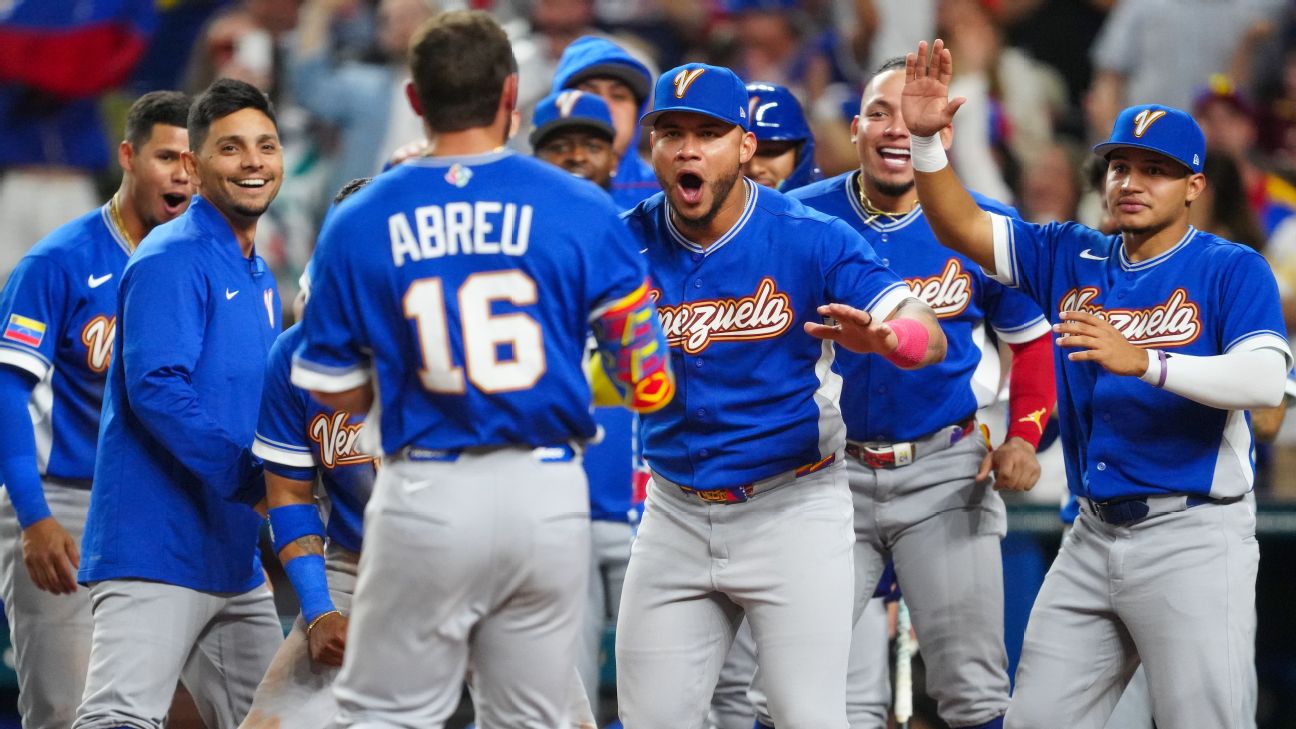
Defending champion Japan is out. Venezuela rallied from a 5-2 deficit to shock Shohei Ohtani and the Samurai with an 8-5 victory in Saturday's WBC quarterfinal at loanDepot Park, powered by Wilyer Abreu's go-ahead three-run blast that traveled 409 feet off Sawamura Award winner Hiromi Itoh. In the other quarterfinal, Italy continued its Cinderella run with an 8-6 win over Puerto Rico, setting up a Venezuela-Italy semifinal on Monday night that virtually no AI model projected before the tournament began. For futures bettors and anyone tracking AI prediction accuracy, this was the single most instructive day of the 2026 WBC.
This game opened with a moment that may never happen again in international baseball. Ronald Acuna Jr. led off the top of the first with a home run for Venezuela, and then Shohei Ohtani answered with a leadoff homer of his own in the bottom of the first. It was the first game in WBC history to feature back-to-back leadoff home runs. Japan built a 5-2 lead through three innings, adding homers from Shota Morishita, and the defending champions looked in complete control.
Then Venezuela's bullpen locked in. Six relievers combined for 6 1/3 scoreless innings, shutting Japan down completely after the third. The offensive explosion came in the sixth inning when Maikel Garcia launched a two-run homer to cut the lead, and then Wilyer Abreu jumped on a 2-1 four-seam fastball from Itoh and crushed it 409 feet to right field for the go-ahead three-run homer. Japan never recovered. Ohtani came to the plate with two outs in the ninth against Daniel Palencia and flied out to end it. Japan's manager, Hirokazu Ibata, announced his resignation after the loss.
Most AI prediction models, including our own experimental frameworks here at Daily MLB Picks, had Japan as one of the top two favorites entering the quarterfinals. The logic was sound on paper: Japan had won the 2023 WBC, had Ohtani in the lineup, and featured a deep pitching staff anchored by NPB's best arms. The models weighted historical tournament performance, roster talent aggregation, and starting pitching quality. All of those inputs pointed to Japan advancing comfortably.
But here is where AI models consistently struggle with short-tournament formats: they underweight bullpen depth in high-leverage situations and overweight name recognition. Venezuela's bullpen was not the flashiest unit on paper, but six arms combining for 6 1/3 scoreless innings in an elimination game is a level of collective performance that models have difficulty pricing. Tournament baseball is not a 162-game sample. It rewards hot streaks, clutch hitting, and bullpen endurance over a three-hour window. That is exactly what Venezuela brought on Saturday night.
In the first quarterfinal of the day, Italy defeated Puerto Rico 8-6 to reach the WBC semifinals for the first time in the program's history. Italy jumped ahead early with a four-run first inning, highlighted by three straight RBI singles from Vinnie Pasquantino, Dominic Canzone, and Jac Caglianone, followed by a J.J. D'Orazio sacrifice fly. They extended the lead to 8-2 after four innings before Puerto Rico mounted an eighth-inning rally that fell short.
Italy entered the WBC at 80-to-1 to win the championship and has now shortened all the way to +750. That is an extraordinary shift in the futures market, and it represents the kind of live-odds value that AI models can flag in real time if they are calibrated for tournament variance. The Italian roster is built around MLB-level talent like Pasquantino, Canzone, and Caglianone, but models that focused purely on team pedigree and tournament history would have dismissed them entirely.
The futures board shifted dramatically after Saturday's results. Venezuela, which opened the tournament at +900 to win it all, is now sitting at +360. That is a massive move, but given what we saw from their bullpen and the middle of their lineup, there is a legitimate argument that the market still has not fully adjusted. Italy at +750 represents a fascinating long shot for anyone who believes in their pitching depth and the momentum they have built through an unbeaten run.
Monday's semifinal has Venezuela as a -170 favorite over Italy, with the spread at Venezuela -1.5. The other semifinal features the United States against the Dominican Republic on Sunday night, with the championship game set for Tuesday, March 17 at loanDepot Park. For AI models tracking these markets, the key variable now is how to properly weight momentum and bullpen usage in a condensed tournament schedule. Venezuela's six relievers threw a combined 6 1/3 scoreless innings on Saturday, but how available are those arms for a Monday start?
For futures bettors looking past the WBC and into the regular season, Venezuela's upset is packed with actionable information. Wilyer Abreu, who plays for the Red Sox, just demonstrated elite power and clutch ability on the biggest international stage. If Boston's lineup projections do not account for Abreu taking a step forward this season, there could be value on their win total. Maikel Garcia, the Royals' shortstop, showed that his power game is developing faster than most models expected. Kansas City is already a trendy pick to outperform this year, and Garcia's WBC performance only reinforces that thesis.
On the pitching side, the Venezuelan bullpen's dominance is worth tracking back to individual MLB teams. Daniel Palencia, who closed out the game against Ohtani, is a name that could carry real confidence into April. The WBC is giving us free data on which players are locked in, which arms are sharp, and which hitters are seeing the ball well heading into the regular season. AI models that incorporate WBC performance data into their early-season projections will have an edge over those that treat the tournament as noise.
Venezuela's upset of Japan is exactly the kind of result that exposes the gaps in traditional modeling approaches. Models that rely heavily on historical team strength, roster talent aggregation, and name value will always struggle with short-tournament formats where bullpen depth, hot hitting, and in-game management become the dominant variables. The best AI models are the ones that can adapt their weighting in real time, recognizing that a three-game tournament is a fundamentally different animal than a 162-game season.
If your model had Japan advancing comfortably, that is not a failure of the model itself. It is a signal that the model needs a tournament-specific adjustment layer. Venezuela's comeback, Abreu's 409-foot blast off Japan's best pitcher, and six scoreless bullpen innings are the kinds of variables that require dynamic recalibration. The WBC semifinals are set. Venezuela faces Italy on Monday, and the United States takes on the Dominican Republic on Sunday. Both games will be another test for whether AI prediction frameworks can keep up with the beautiful chaos of international baseball.